
The brief
The client needed a solution to automate the process of editing thousands of PDF documents in bulk.
The goal was to save time and reduce errors by allowing users to update multiple PDFs with the same information at once.
PDF editing and generation software whose main feature uses placeholder values from a CSV file to batch edit PDFs with matching placeholders.
Client
Under NDA
Disciplines
Software development, PDF analysis, Data manipulation
Form factor
Desktop application, Web application
Engagement
Concept through working software
The client needed a solution to automate the process of editing thousands of PDF documents in bulk.
The goal was to save time and reduce errors by allowing users to update multiple PDFs with the same information at once.
Editing one PDF by hand is trivial. Editing the same PDF a hundred different ways, correctly, without anyone checking each one by eye, is a different problem entirely.
We treated the template and the data as two independently validated inputs rather than one combined process. The template is parsed once to find its placeholder fields; the data file is checked against those fields before generation ever starts, so a mismatched column is caught immediately instead of surfacing as a garbled document 80 rows in.
Generation itself runs row by row with its own error boundary, so a failure on one row is recorded and skipped rather than aborting the batch - the client gets every document that could be generated, plus a clear account of the ones that couldn't and why.
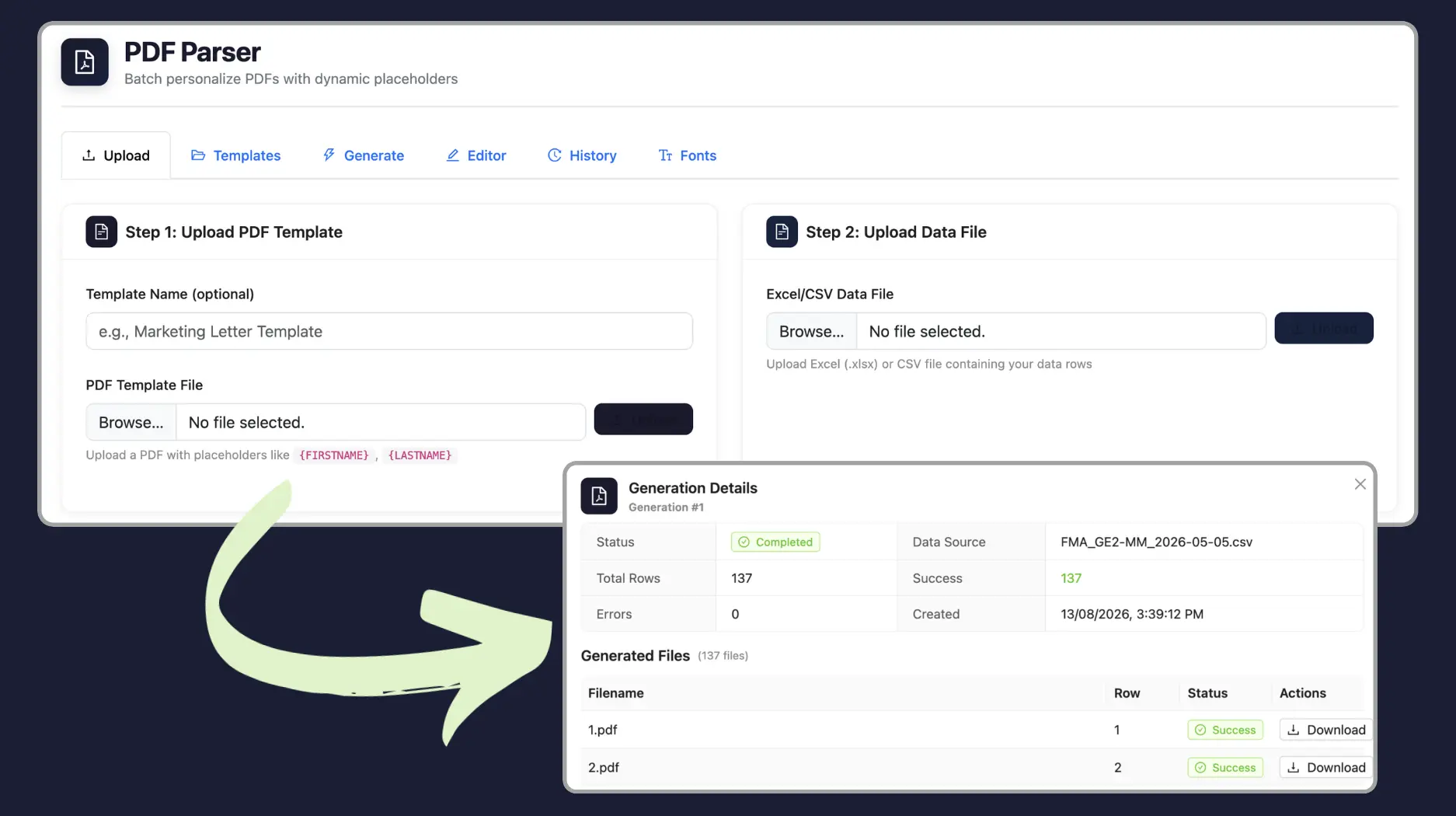
A two-step flow: upload the PDF template once, then upload a data file to generate a document per row against it. The same template can be reused across as many data files as the client needs, without re-uploading or reconfiguring it each time.
Every run produces a generation report - rows processed, successes, and errors - alongside individually downloadable output files, so the client can see exactly what happened to every row without opening each PDF to check.
The figures below were measured against the client's previous manual process.
The tool now runs the client's recurring document batches directly, with new templates onboarded as new document types come up rather than each one needing custom development. It fits the pattern described in Scaling Operations for the Next Decade: high volume, highly consistent, and low consequence per document.
This engagement is covered by a confidentiality agreement, so the client is not named and some implementation detail is described in general terms.
Related solutions
Next project
Internal Database Chatbot for Enterprise